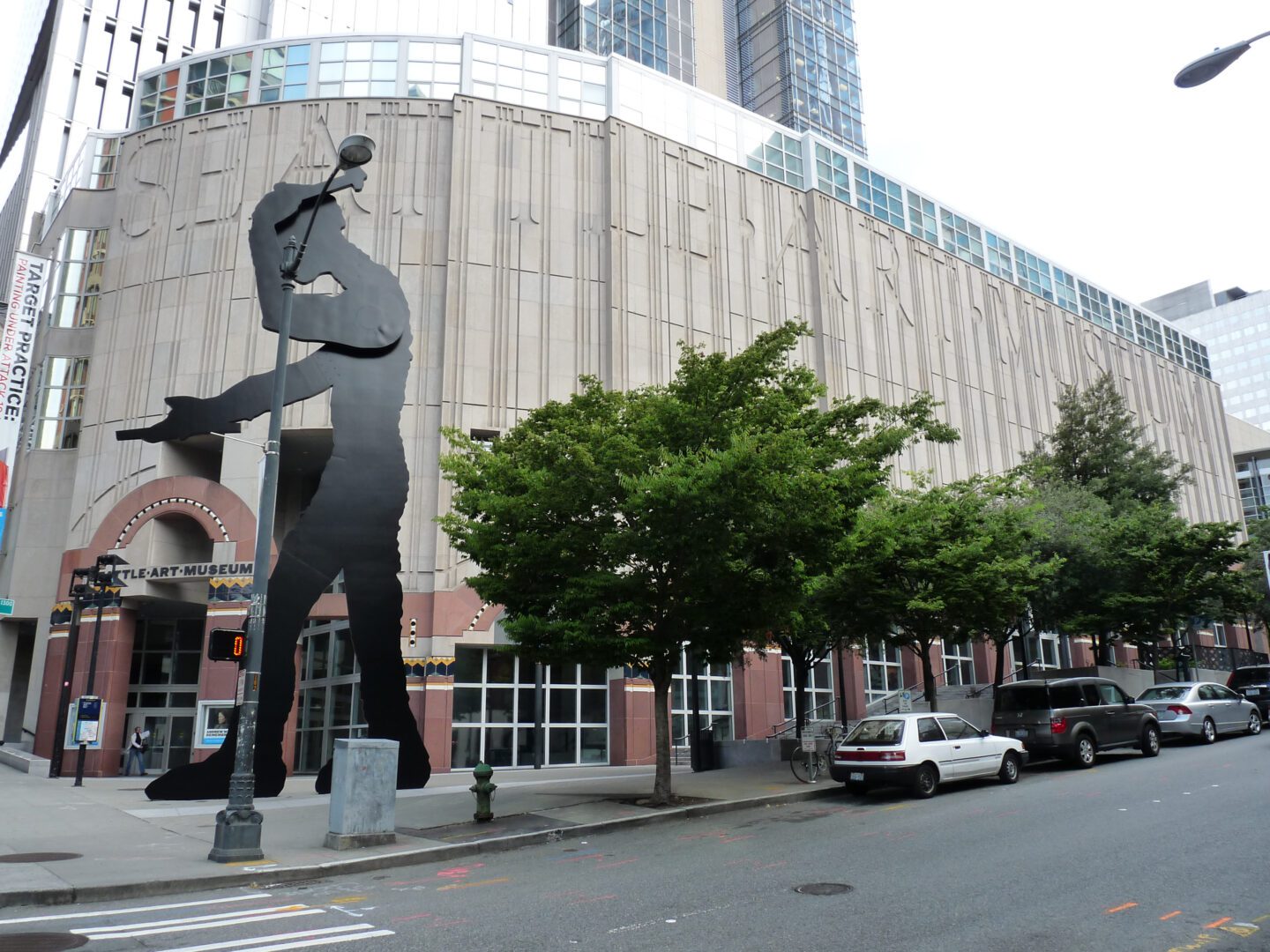
Hammering Man, by Jonathan Borofsky (1991), Seattle Art Museum


-
Hammering Man, by Jonathan Borofsky (1991), Seattle Art Museum
In the early 1990s, the Seattle Arts Commission (now the office of Arts & Culture) instituted an artist-initiated project, “In Public: Seattle 1991,” that responded to a levy passed to construct a new Seattle Art Museum (SAM) building in downtown Seattle. Representatives from the Arts Commission and SAM collaborated on a project which was funded by the 1% for Arts program and a donation from the Virginia Wright Fund. The total budget was $847,000 (over $2 million in 2025 dollars).
One of the most iconic works produced for the “In Public” program was Jonathan Borofsky’s (b. 1942) Hammering Man, a work sited at First Avenue and University Street directly in front of the museum. Hammering Man is a 48-foot-high steel silhouette of a working man methodically hammering up and down four times per minute. This work alone utilized over half of the “In Public” budget for its fabrication and installation. After a rigging mishap in 1991, Hammering Man was permanently installed in 1992.
Seattle’s version is one of six large-scale steel “hammering men” throughout the world, the others being in Berlin, Seoul, Los Angeles, Dallas, and Basel. Borofsky describes the Hammering Man: “I want this work to communicate to all of the people of Seattle not just artists, but families young and old. I would hope that children who see the Hammering Man at work would connect their delight with the potential mysteries that a museum could offer them in their future. At its heart, society reveres the worker. The Hammering Man is the worker in all of us.”
In 1979, Borofsky made his first “hammering man” about 11 feet tall out of plywood. He painted it black and motorized the arm. His original idea was to have many hammering men, all hammering at different locations around the world, all at the same time—connecting us all together. Today, there are numerous wooden indoor hammering men of different sizes that hammer all over the world, in addition to the large steel outdoor sculptures.
Interestingly, this sculpture was the object of guerilla art shortly after its installation. In 1993, a group of artists fabricated a 6-foot sheet-metal ball, 19 feet in circumference and attached it to the sculpture via nine links of chain made of plate steel and a 5-foot shackle. The event strove to raise awareness about the oppression of working people. The ball and chain were removed after two days, and Hammering Man remained unharmed.
From here, walk north up 1st Avenue, passing Pike Place Market, to Stewart Street. Turn right on Stewart and proceed to the South Lake Union Streetcar stop at Westlake Avenue.