Literacy/ESL/World Languages (LEW) Floor, by Ann Hamilton (2004), Seattle Central Library

-
Literacy/ESL/World Languages (LEW) Floor, by Ann Hamilton (2004), Seattle Central Library
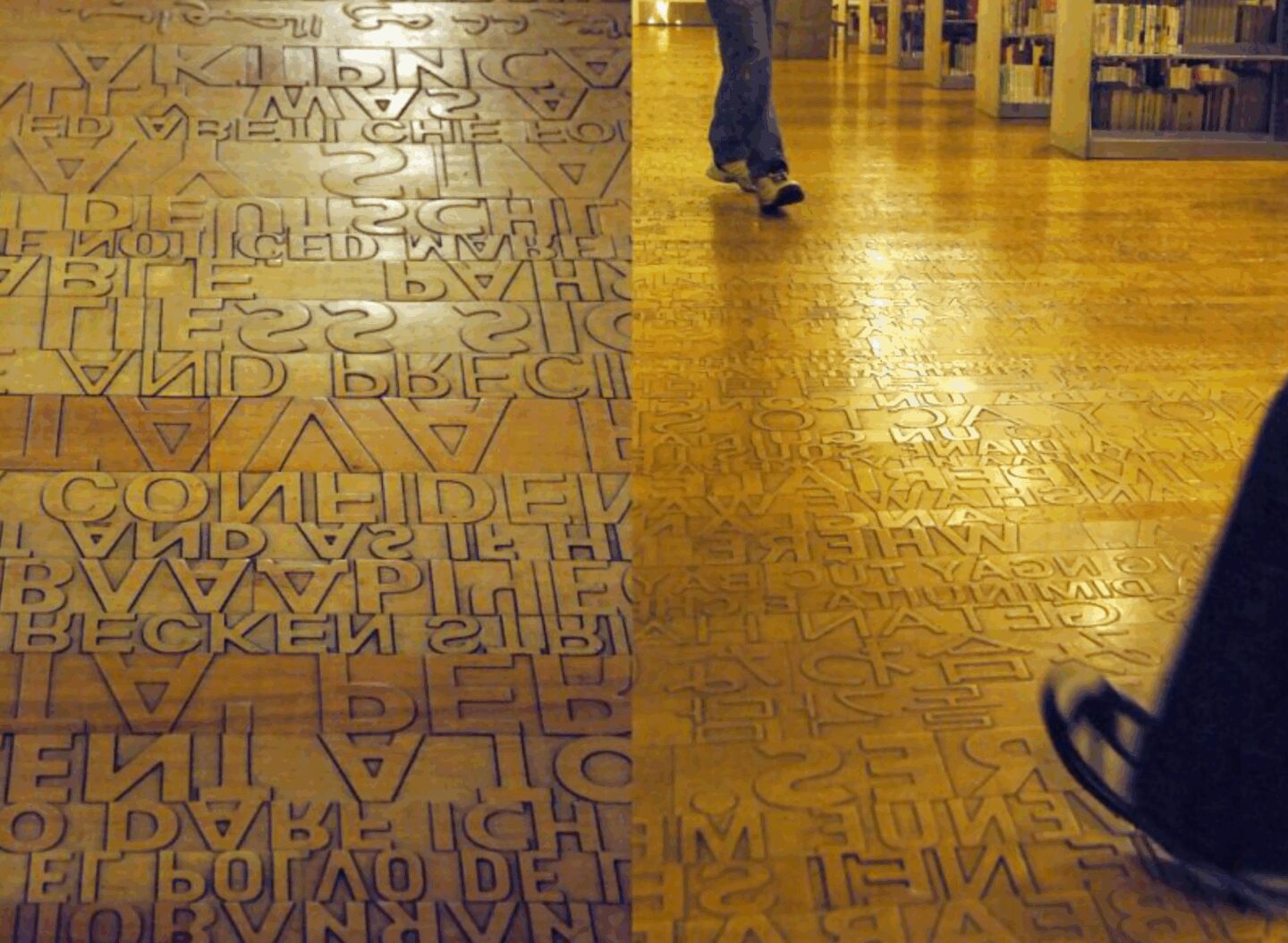
When you enter the library at the 4th Avenue entrance, look down and to your right (or to your left from the elevators). The work covering the floor was created by Ann Hamilton (b. 1956), an internationally acclaimed artist known for her large-scale multimedia installations, public projects, and performance collaborations. She describes her artistic practice as a “site-responsive process [that] works with common materials to invoke particular places, collective voices, and communities of labor.” Hamilton was selected in a national search to produce a site-responsive, integrated work and the result is something so seamlessly integrated into the library’s first level that some don’t realize they are walking right over it. Literacy/ESL/World Languages (LEW) Floor was created in 2004, funded by the 1% for Art component of the Libraries for All bond measure, for the opening of the Central Library. Through texture and form, Hamilton’s piece evokes the tactile experience of book production and reading. It responds directly to a time of technological transition in book production, when reading a book in print form is no longer the only way to read. She specifically acknowledges the form and facilities of the new Central Library that reflect the changes technology has had on a reader’s relationship to the physical book and text on a page, how books convey information, and the role the library plays in providing access to print culture.
The work covers 7,200 square feet of floor space in the library’s LEW Collection (Literacy, ESL/English as a Second Language, and World Languages). The work consists of 556 lines of maple floorboard of relief letter forms that, like moveable metal or wood type, are inverted. This inversion references historical printing techniques—letters and symbols carved backward on type block and then placed in reverse order in a frame so that, when printed on the paper surface, read correctly. To understand the text on the floor, you must read it backwards. Hamilton likens this to the experience of learning to read where symbols, once meaningless, over time ultimately become words and gain meaning. The placement here is significant because this level of the library, between the LEW Collection and the Faye G. Allen Children’s Center, is the place where new-language learning and learning to read happen. The embedded text is made up of 1,543 “first sentences” gathered by patrons and librarians from books in the Seattle Public Library Fiction and LEW Collection, in its most frequently used languages: Arabic, Chinese, English, French, German, Italian, Japanese, Korean, Russian, Spanish, and Vietnamese.
To view the next set of work, cross back in front of the elevator bank to the north side of Level 1 and enter the Faye G. Allen Children’s Center.